
Symptoms, timeline & priorities
What changed, when did it start, and what makes it better or worse? How does it affect daily life? We review prior evaluations, treatments tried and the improvements that matter most to you.
TruDiagnostic™
Explore your biological age and functional health with specialized epigenetic testing, interpreted with your Astra care team.
Understand the science
Epigenetics explores how gene activity is regulated. Chemical marks on DNA can be influenced by aging, environment and daily habits without changing the DNA sequence itself.
At Astra, the conversation begins with you: what you want to understand, what you already know about your health and how additional information could help shape your next step.
Epigenetics explained · MedlinePlus01 / Your initial visit
A comprehensive assessment connects your symptom history, daily routines, examination and existing results. These are examples of the questions that help your clinician identify priorities and decide whether additional testing would be useful.
What changed, when did it start, and what makes it better or worse? How does it affect daily life? We review prior evaluations, treatments tried and the improvements that matter most to you.
Which conditions, surgeries or hospitalizations have you had? Which illnesses run in your family, and at what ages did they develop? Relevant reproductive or hormonal changes also help establish context.
What prescriptions, over-the-counter medicines, hormones, vitamins or herbal products do you use—and at what doses? We ask about recent changes, benefits, side effects, allergies and previous reactions.
What do you eat and drink on a typical day? Have you restricted foods, noticed digestive symptoms or experienced unintended weight changes? Your eating pattern and symptom history guide any further nutritional evaluation.
How much time do you spend active or sitting? What aerobic or strength activity do you do? We ask whether pain, fatigue, breathlessness or changes in strength limit exercise or everyday tasks.
How long and how regularly do you sleep, and do you wake refreshed? Snoring, breathing pauses, daytime sleepiness and shift work may point to issues that need a focused sleep assessment.
Have you noticed low mood, loss of interest, persistent worry or stress affecting your functioning? Validated depression or anxiety questionnaires may be selected according to age and clinical context, with further evaluation when indicated.
Do you currently smoke or vape, or have you in the past? How much alcohol do you drink, and do you use other substances? We also ask about relevant exposures at work or home.
Do food costs, housing, transportation, personal safety or other responsibilities make care harder to follow? Who can support you? These questions help make recommendations practical for your circumstances.
Your clinician reviews relevant examination findings, blood pressure, weight trends and prior laboratory results. Glucose, cholesterol or other conventional tests and preventive screenings are selected according to your symptoms, age and risk—not as a required panel for everyone.
What do you hope to learn, and how could the result change your care? Before ordering, discuss the evidence, limitations, cost and alternatives. Epigenetic age estimates have uncertain individual clinical utility; a care plan can also proceed without epigenetic testing.
These conversation topics combine IFM’s history-taking framework with established preventive-care recommendations. They are adapted discussion prompts, not a validated questionnaire specifically required before epigenetic testing. Your clinician selects the appropriate tools and follow-up; a positive screening result needs clinical evaluation.
Examples include PHQ-2/PHQ-9 for depression and GAD-2/GAD-7 for anxiety. USPSTF recommends routine anxiety screening through age 64; evidence is insufficient for routine screening at 65 or older. Symptoms at any age still require appropriate clinical assessment.
If testing is chosen, follow TruDiagnostic’s sample-collection instructions and confirm arrangements with our team. Bring your medication and supplement list and relevant previous results to your visit.
Specialized tests by TruDiagnostic

Biological aging
Estimates biological age and pace of aging from DNA methylation patterns.
$425 USD · test only

Functional health
Uses methylation-based surrogate markers to explore patterns related to nutrition, metabolism and inflammation.
$425 USD · test only

A combined option brings both reports together from one sample. Your provider can help you decide which approach fits your goals.
$750 USD · both tests only · save $100
Epigenetic scores are estimates. They support a broader clinical conversation and do not diagnose disease, replace standard testing or guarantee a particular health outcome.
Inside your report
These are some of the biomarkers and scores we can explore together. Your symptoms, history and goals help us decide which findings deserve attention.
OMICmAge · DunedinPACE
Compare estimated biological age with calendar age and explore your pace of aging.
SYMPHONYAge
Estimates across 11 organ systems, including the brain, heart and liver, add context to the overall age score.
Vitamin D · Choline · Omega-3 · DHA
Explore nutrition-related signals alongside your diet and supplement use.
Glucose · HbA1c · LDL-C · Triglycerides
Patterns to discuss alongside blood pressure, metabolic history and conventional lab results.
CRP · IL-6 · CD4/CD8
Signals that may help focus further evaluation when interpreted with symptoms and medical history.
Cortisol · DHEA-S · ATP5B · NAD+ pathways
Explore patterns related to stress physiology and energy metabolism in the context of sleep, recovery and daily habits.
TruHealth markers are estimates derived from DNA methylation, not direct blood concentrations. A finding may lead us to review habits or order a conventional test before deciding on treatment. Changes over time are interpreted with your clinical progress; a score alone does not diagnose disease or prove that a treatment worked.
Take a look before you test
Open a sample, explore the measurements and bring your questions to your visit. Both PDFs are in English and can be downloaded without signing up.
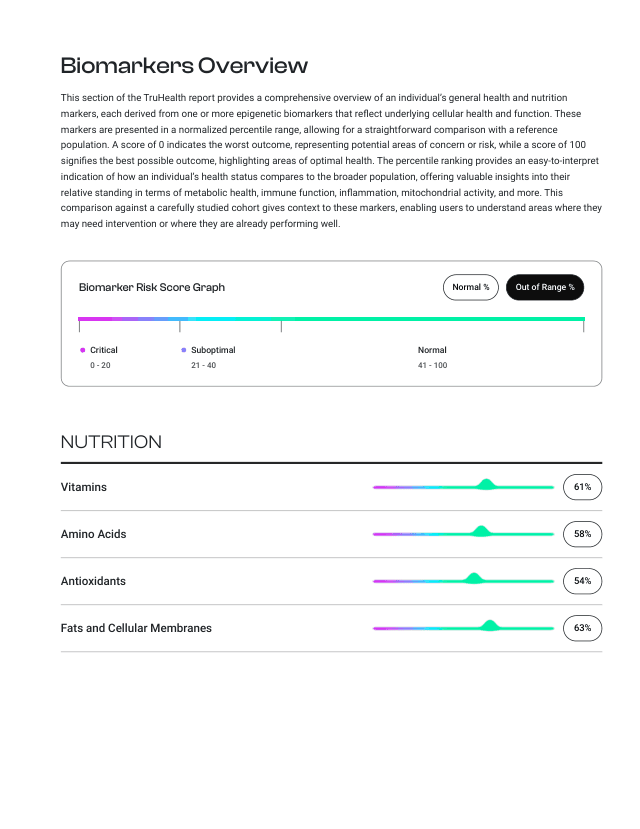 Sample report
PDF · English · 29 pages · 5.0 MB
Explore nutrition and functional-health sections, reference comparisons and explanations of individual epigenetic markers.
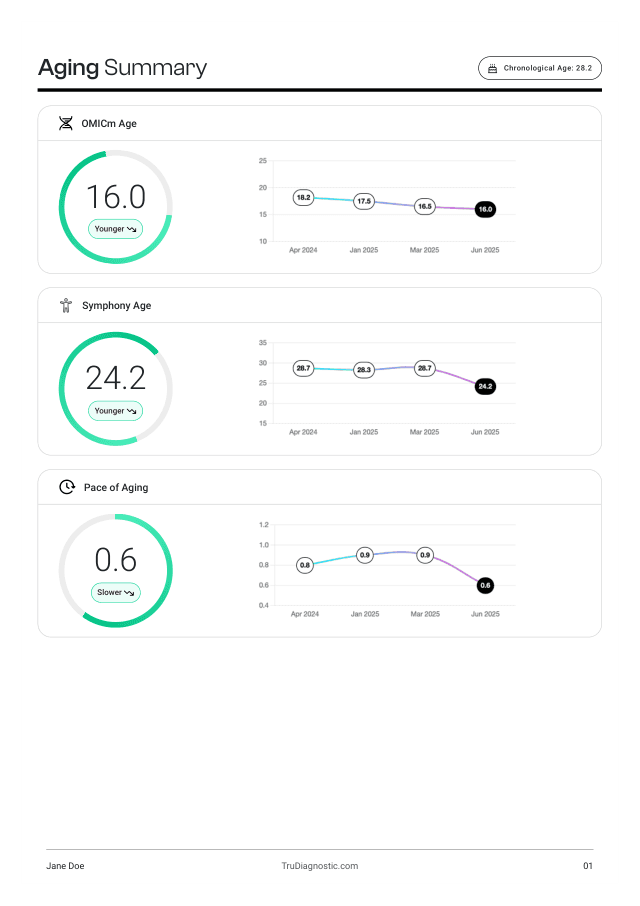 Combined sample report
PDF · English · 53 pages · 8.4 MB
See how biological age, pace of aging, organ-system estimates and functional-health findings appear together in a sample report.
These documents contain sample or illustrative results, not your personal results or a promise of improvement. Report layouts, included markers and reference ranges may change; your provider will explain the version you receive.
02 / Your test, step by step
A provider-guided test with at-home collection. Here’s how your sample becomes a report you can review together.
After your assessment, your provider selects TruAge, TruHealth or both and arranges for the kit to be shipped to your home when appropriate.
The kit includes collection and return materials. Confirm registration with our team and read the instructions before collecting; the lab needs a registered kit to process your sample.
Use the supplied finger-prick kit to collect a small blood sample at home. Follow the kit’s collection, drying and packaging directions. Contact our team if you need help.
Return the sample using the prepaid materials provided. TruDiagnostic’s CLIA-certified laboratory analyzes DNA methylation patterns and prepares your report.
When the report is ready, your included results-review visit connects the findings with your history, questions and care plan. Together, decide on the next steps.
TruDiagnostic estimates about 2–4 weeks after its lab receives the sample for provider-ordered kits. Shipping time is separate, and turnaround may vary.
03 / From results to follow-up
Once your results are available, your second included visit connects the report with your clinical evaluation and a plan you understand.
Review biological age, pace of aging and organ-system estimates with TruAge; explore nutrition, metabolic, immune, inflammation and other methylation-based signals with TruHealth.
Reference comparisons help explain a result. A higher or lower value is not always better; interpretation depends on the marker and report. These estimates differ from direct blood measurements.
Connect findings with your screenings, symptoms and history. If needed, your provider may order additional labs, personalized testing or diagnostic studies, or recommend additional assessment technology.
Discuss nutrition, movement, daily habits and appropriate treatment options, including alternatives and their evidence, benefits and risks. The aim is to address modifiable factors and possible underlying causes; results vary.
Follow up over time, often at 3 or 6 months, to review changes in symptoms, wellbeing and relevant measurements. Together, assess your response to treatment, adjust the plan and decide whether repeat testing is clinically useful.
Later follow-up consultations may have a lower fee than the initial $399 two-visit consultation. Confirm the follow-up fee before scheduling.
If the tests are repeated, the test price remains $425 each or $750 for both, charged separately from follow-up.
Ask about follow-upA single epigenetic score cannot identify the cause of a symptom or prove that aging or disease has been reversed. Additional evaluation may be needed before making treatment decisions.
Explore TruDiagnostic reports04 / Your consultation & testing
Epigenetics consultation
$399 USD
Tests are charged separately. Additional labs, diagnostic studies, treatments and any monitoring or assessment devices needed for your care plan are priced separately.
Book my initial visitChoose the testing option that fits your clinical assessment and goals.
All prices in USD. Each total includes the two consultation visits and the selected test option. Any additional services are priced separately.
Options for your next step

Learn about optional Cherry payment plans for your care at Astra Medical Group. Open the portal to review available options and terms.

Explore financing for your care and continue to the secure CareCredit application.





Financing is subject to approval and provider terms. Confirm the options available for your service; estimates are not a quote or an approval.
Before your visit
Bring your questions. We’ll help you understand your options.
Genetic tests examine the DNA sequence. Epigenetic testing examines chemical marks, including DNA methylation, that can influence gene activity without changing that sequence.
No. These are statistical estimates, not a diagnosis or a prediction of your lifespan. They complement clinical evaluation and do not replace screening or conventional diagnostic tests.
TruHealth reports methylation-based surrogate markers. These are different from direct blood measurements; your clinician may recommend conventional testing to investigate a finding.
The $399 fee includes your initial clinical visit and a second visit to review results and discuss treatment options. Tests are charged separately. Additional labs, diagnostic studies, treatments and any monitoring or assessment devices needed for your care plan are priced separately.
Follow-up may be recommended at 3 or 6 months. Your provider decides whether repeat testing is useful. Later consultation fees may be lower; confirm before booking. Repeated tests remain $425 each or $750 for both, separate from the visit.
TruAge and TruHealth are $425 each, or $750 together. With the $399 two-visit consultation, the starting total is $824 for one test or $1,149 for both. Prices are in USD; additional services are separate.